ServicesPool Repair
Pool Repair in Phoenix
When your pump hums without starting, your filter pressure climbs or your heater clicks and quits, we trace the fault to the exact part. You get a clear explanation of what failed, why it failed and what each repair option means before we touch a wrench.
What Pool Repair Covers and When It Makes Sense
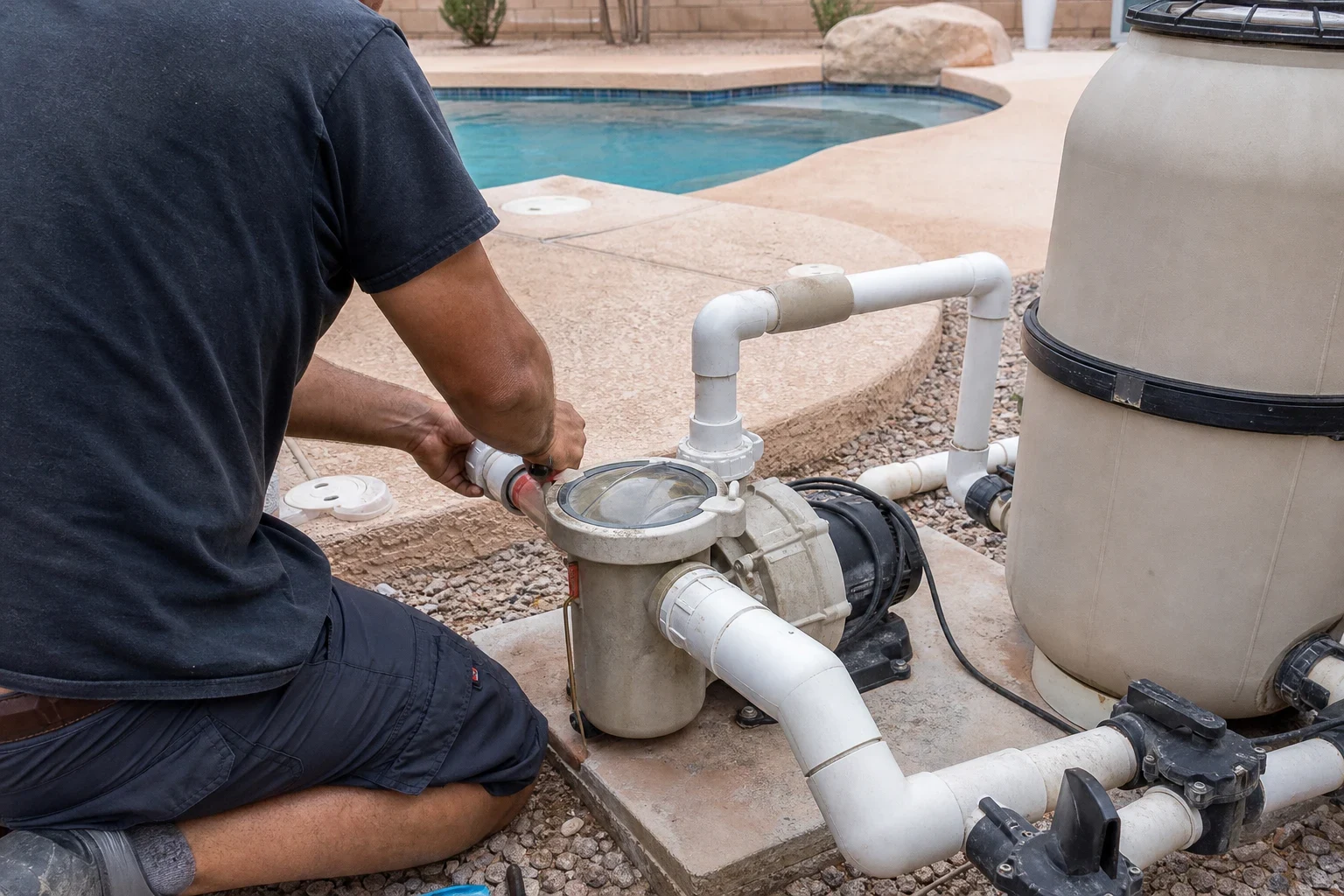
Most repair calls come down to a short list of parts at your equipment pad: the pump motor and its start capacitor, the shaft seal between motor and pump housing, the filter tank and its O-rings, the heater, the valves and the PVC fittings that tie it all together. Our job is to find which one failed and tell you plainly what caused it.
Often the fix is small, like a new capacitor or a gasket. Other times a motor with seized bearings on an aging pump is better replaced than rebuilt. In that case we say so and explain what our equipment installation work would involve, so you can compare both paths with the facts in front of you.
Summer pump runtimes in Phoenix are long, which wears bearings and heats capacitors faster than in milder places. That is why we check the parts around a failure too, not just the one that quit.
Parts and Systems We Repair
Pumps and motors
We replace start and run capacitors, worn motor bearings, shaft seals and cracked pump lids. We also clear impellers jammed with leaves, pebbles or hair, which is a common reason a pump runs but moves little water.
Filters and valves
For cartridge, sand and DE filters, we replace tank O-rings, broken DE grids and laterals, stuck pressure gauges and worn multiport spider gaskets. A worn spider gasket lets water bypass the filter media entirely.
Heaters and heat pumps
We troubleshoot ignition faults, pressure switch errors and low-flow shutdowns. Many heater errors trace back to a dirty filter starving the heater of water flow, so we check that first.
Equipment pad plumbing
We cut out and replace cracked PVC fittings, failed unions and diverter valves above ground at the pad. Sun exposure makes older PVC brittle over time.
Timers and controls
Mechanical timers with worn trippers and simple control boards get tested and replaced so your pump runs on the schedule you expect.
Signs Your Pool Equipment Needs Repair
Motor buzzes without turning
A pump that buzzes but never gets the shaft moving most often has a dead start capacitor. Switch it off, since a stalled motor left under power can overheat in minutes.
Grinding or screeching noise
A shrill whine or a grinding sound comes from worn motor bearings. Replacing the bearings or the motor early protects the shaft seal and pump housing from damage.
Water dripping under the pump
A puddle where the motor joins the pump housing usually means a worn shaft seal. If it keeps leaking, water reaches the motor and rusts the bearings.
Air in the pump basket or bubbles at the returns
A half-empty pump basket means air is being pulled in on the suction side. Typical culprits are a dried-out lid O-ring, a loose drain plug or a cracked fitting ahead of the pump.
Filter pressure stays high after cleaning
A high reading right after the filter was cleaned can mean a stuck gauge or a restriction downstream of the filter. Check both before you buy new media.
Heater clicks but never fires
Clicking with no flame usually traces to low water flow, a bad pressure switch or an ignition fault. We test them one at a time, in that order.
What Happens From Your Call to the Fix
- 1
You describe the symptoms
Explain what the equipment is doing, what it sounds like and any codes on the display. We ask for the brand and rough age of the unit, give you a free quote and schedule a visit.
- 2
Testing at the equipment pad
We meter the capacitors, measure the motor's amperage draw, read filter pressure and run the system to watch flow. Anything worn or broken gets photographed so you can see it yourself.
- 3
A plain explanation of your choices
You hear which part failed, what caused it and whether a repair or a replacement fits your setup better. We wait for your approval before going further.
- 4
Install, test and tidy up
We fit the new part, prime the pump, check every fitting we touched for drips and confirm pressure and flow are back where they belong. Old parts leave with us unless you ask to keep them.
What Changes the Price of Your Repair
The biggest variable is the part itself, followed by what turns up once we open the pump, filter or heater. Every line on your quote comes with an explanation before you approve anything, so the final bill matches what you agreed to.
- Which part, which brand
- An O-ring or capacitor is a small line item next to a motor or a heater control board. Certain manufacturers use proprietary parts that run higher than generic equivalents.
- How old the equipment is
- Older pumps and heaters tend to hide a second worn part behind the first. When replacing the unit would cost you less over time, we say so.
- Whether the part is still made
- Parts for current models are easy to get. A discontinued pump or heater may need a special-order part or an adapter kit, which adds time and cost.
- Hidden damage
- A shaft seal that has been leaking for weeks can let water reach the motor bearings and rust them. You see photos of that damage before it is added to the job.
Pool Repair Questions
Something not covered here? (602) 883-2314
Should I repair or replace my pool pump?
If the motor is relatively young and the problem is a capacitor, seal or bearings, repair usually makes sense. If the motor is old, has failed before, or the pump housing is cracked, replacement is often the better value. We give you both options with the reasons, and you choose.
Can you tell what is wrong over the phone?
Sometimes we can narrow it down. A hum with no spin points to a capacitor, and water under the pump points to a shaft seal. We still confirm at the equipment pad before quoting the final repair, because similar symptoms can have different causes.
Is it safe to keep running a noisy pump?
A pump with failing bearings can usually run for a short time, but the noise means wear is speeding up. A pump that hums without spinning should be turned off right away, since it can overheat. When in doubt, switch it off at the breaker and call us.
Will my pool turn green while the equipment is down?
Without circulation and filtration, algae can take hold within days in hot weather. Brushing the walls and keeping chlorine up helps buy time. If the water has already turned, our green to clean recovery service clears it after the repair.
Do I need to be home for the repair?
Not usually. The equipment pad is outside, so we need gate access and the breaker location. We send you the findings and photos so you know exactly what was done.
Get a Straight Answer on What Broke
Describe the noise, the leak or the error code you are seeing, and we will walk you through the likely cause and each fix. Your quote costs nothing, and no work starts until you say yes.